How to Choose an Ethical Elephant Experience in Chiang Mai
Chiang Mai has more elephant “experiences” than almost anywhere on earth, and choosing between them is genuinely hard. Nearly every one calls itself a sanctuary. A lot of them aren’t. If you care about getting this right — and if you’re reading this, you probably do — here’s how to tell the difference, from a small operator that has spent a long time thinking about where the line sits.
The word “sanctuary” doesn’t mean much
Start here, because it saves a lot of confusion: there’s no protected definition of an elephant “sanctuary” in Thailand. It’s a marketing word. A place can print it on the sign, use it across its website, and still offer rides in the back field. So the label tells you almost nothing. What tells you everything is what actually happens once you’re there — and, crucially, what the elephants are asked to do all day, every day, long after your group has gone home.
Red flags: if you see these, walk away
- Riding. The clearest line of all. Elephants aren’t built to carry people, and the training that makes them accept a saddle is not something you want your money funding.
- Bathing or washing “with the elephants.” It’s marketed as gentle and natural, but an elephant scrubbed a dozen times a day for a queue of tourists isn’t bathing — it’s working a shift. Repeated on demand, it’s just riding without the saddle.
- Constant hand-feeding on demand. A basket of bananas sounds harmless, but feeding on cue all day turns a wild animal into a vending machine and keeps it fixated on people for food rather than living its own day.
- Performances. Painting, football, tricks, tourists posing lying across a trunk. Behaviour like that is only reliable through methods no ethical visitor would want to pay for.
- Chains, bullhooks, and back-to-back groups. If the animals are shuffled between tour groups from open to close with no real downtime, “sanctuary” is doing a lot of heavy lifting on that sign.
Green flags: what good actually looks like
- Distance. You watch; you don’t handle. The best experiences keep a respectful gap between you and the animal, and they’re upfront about why.
- Small numbers, unhurried. Fewer visitors, more space, no conveyor belt of groups.
- The animals get a choice. To wander to the water or not, to be near people or not. An elephant that can walk away is telling you something the brochure can’t.
- Honesty about what you’ll see — which is usually less. A place that promises guaranteed trunk selfies is promising you access to the animal, not respect for it.
- People who know the specific elephants, by name and history, rather than a rotating crew of strangers.
Where we land, so you can hold us to it
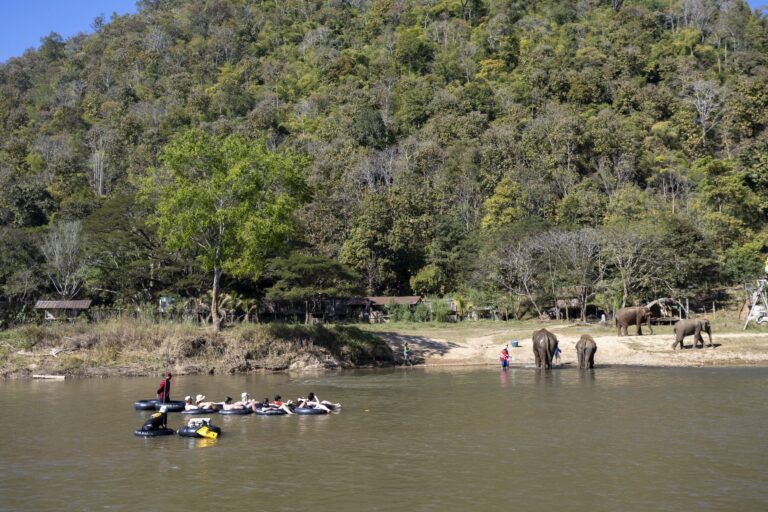
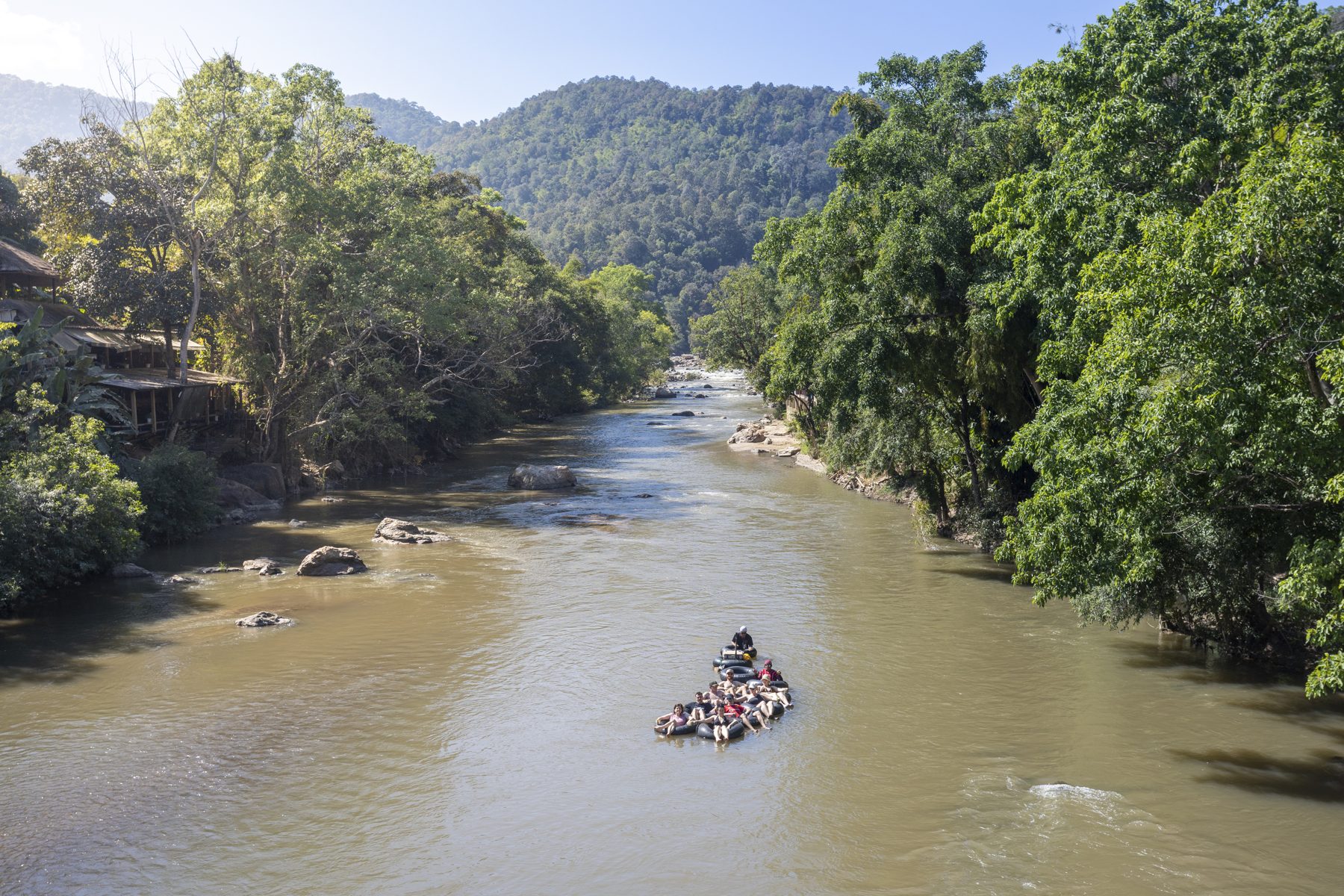
It’s only fair to put ourselves through the same test. Near the end of our tubing route the river passes a small, locally run elephant camp, where the elephants live free along the riverbank. Our policy is observe-only: no riding, no feeding, no bathing, no shows. On our elephant programs you go ashore and watch from a respectful distance for about half an hour, while a guide tells you the real history of elephants in Thailand and how the industry is slowly moving away from riding toward something better. If the elephants are in the river when we tube through, we stop and wait until they’ve moved on. Their day comes first — that part isn’t up for negotiation.
The honest trade-off
Here’s the part most operators won’t say out loud: observe-only means you’ll probably see less than the place with the bathing photos all over its feed. No trunk selfie, no scrubbing a wet elephant, no guaranteed close-up. That’s the deal, and we think it’s the right one. An elephant doing exactly what it wants, at its own pace, fifty metres away, is worth more than any staged moment — and the photo you take of that is one you won’t feel odd about later.
Whoever you end up booking with, ask the plain questions: Can I ride? Can I bathe them? Do they perform? A good answer is a flat no, with a reason. That single question will sort the marketing from the meaning faster than any label on the gate.
Float the river, then watch elephants live their own day — observe-only, always.
See the tubing & elephant tour →Read next: Our elephant policy, in full